The Shape of a Memory You Didn’t Know You Had
There are fragrances that register immediately—you understand them within seconds, place them within a category, decide how you feel. And then there are the ones that take a different route, unfolding slowly, almost imperceptibly, until you realize you’ve been thinking about them long after the moment has passed.
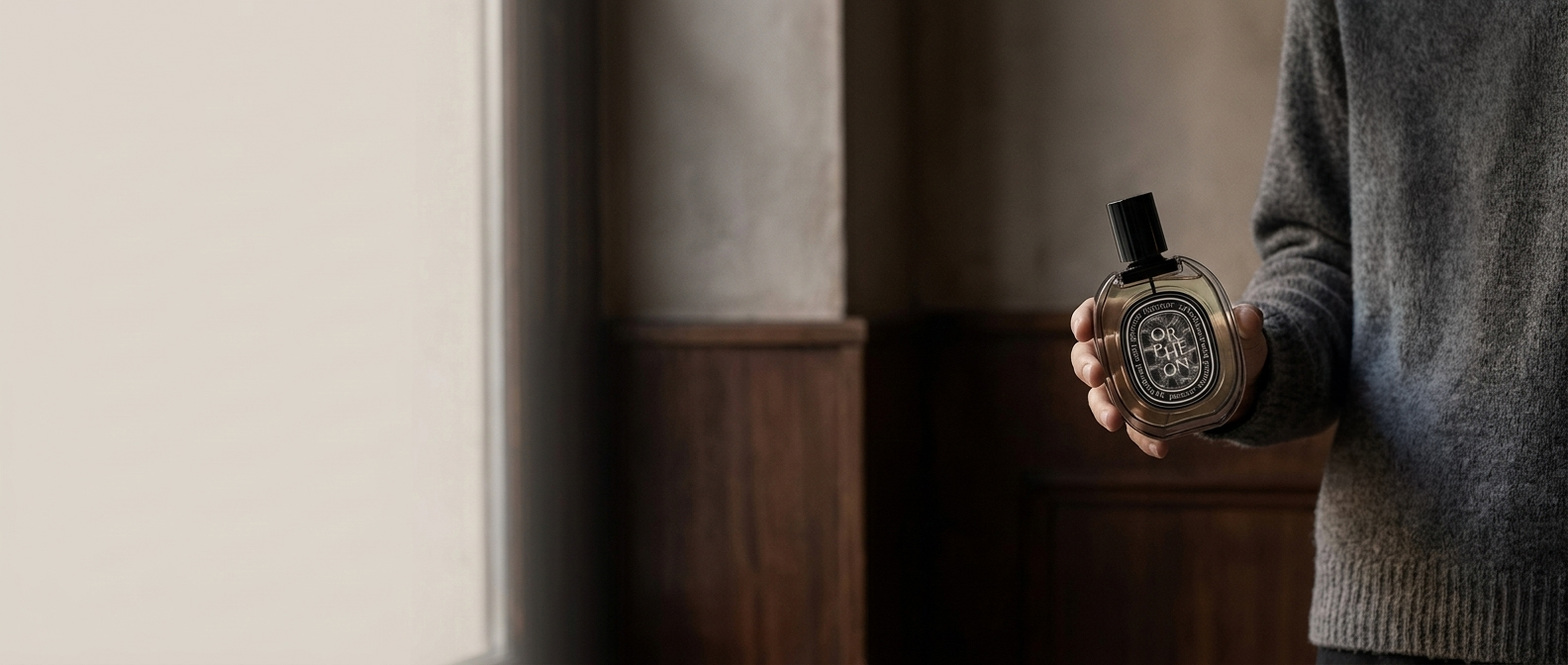
Diptyque Orphéon belongs to the latter.
It’s become something of a quiet phenomenon. Not in the way of a viral fragrance that floods feeds and announces itself through sheer force, but in the way people talk about it after the fact. Someone smells it once and comes back to it. Someone else tries to describe it and can’t quite land on the right words. It circulates through recommendation not as a “must-have,” but as a you have to smell this.
Part of that has to do with timing. The last decade in fragrance has been defined by compositions that are immediately legible. Le Labo Santal 33 built its reputation on a distinct, almost architectural sandalwood—dry, papery, sharpened by Iso E Super, a molecule that gives it that airy, expansive halo. You recognize it from across a room. Maison Francis Kurkdjian Baccarat Rouge 540 took a different route, leaning into density and radiance, a kind of crystalline sweetness that doesn’t so much sit on the skin as it projects outward, catching attention whether you’re looking for it or not.
Diptyque’s Orphéon feels almost like a response to both, though not in any literal sense. It doesn’t reject projection or identity outright, but it softens them. It shifts the focus away from being understood instantly and toward something more atmospheric, more felt than named.
Diptyque traces it back to a bar in Saint-Germain-des-Prés, a place where its founders spent time, surrounded by polished wood, tobacco smoke, and the low hum of conversation.
That context is helpful, but what’s more interesting is how the fragrance avoids turning that reference into something overly literal. There’s no heavy-handed smoke note, no attempt to recreate a room down to its materials. Instead, it captures the impression of being there, filtered through time.
The opening has a clarity to it, a coolness that reads almost like air moving through a space. Juniper gives it that lift, but it doesn’t feel sharp or overtly aromatic. It’s more like the glint of something—glass, light, a passing moment—before it settles into something softer. As it develops, the composition becomes increasingly textural. Powder emerges, but not in a cosmetic or vintage way. It behaves more like a diffusion, a way of softening edges so that nothing feels isolated. Wood is present, but it doesn’t assert itself the way sandalwood often does in contemporary perfumery. It’s rounded, almost ambient, like something that has absorbed years of presence rather than declaring itself upfront.
Voices like Derek Deng and Tracy Wan have shifted the conversation toward something more cultural, more interpretive. Fragrance is less about listing notes and more about articulating experience—how something moves, how it evolves, what it evokes.
What makes Orphéon compelling is that it never fully resolves into a single idea. You can sense the jasmine, but it doesn’t read as floral in any traditional sense. The tonka brings warmth, but without tipping into sweetness. Even the wood, which could easily anchor the entire composition, remains just one part of a larger atmosphere. Everything feels integrated, slightly blurred, as though you’re experiencing it through a layer of memory rather than in sharp focus.
That quality—the slight distance, the softness—is what makes it linger.
Scent has always been tied to memory, but not always in ways that are obvious. It’s rarely a one-to-one reconstruction. More often, it’s a feeling that surfaces unexpectedly, something you recognize before you understand why.
Diptyque’s Orphéon has that effect.
It brings to mind a first encounter with nightlife—not in the literal sense of a crowded room or a specific place, but the feeling of it. The sense of stepping into something new, the energy in the air, the anticipation that sits just beneath everything. There’s a kind of brightness to it, even within its warmth. A buoyancy. The kind of atmosphere that feels expansive and alive, where everything is slightly heightened. It’s easy to romanticize in retrospect, but that’s part of its pull. It doesn’t feel like a recreation so much as a recollection, shaped by time into something more cohesive than it ever was in the moment.
That emotional register is difficult to manufacture, and even harder to sustain throughout a composition. Many fragrances gesture toward nostalgia, but they tend to rely on familiar cues—powder, vanilla, smoke—to signal it. Orphéon does something more subtle. It doesn’t point directly to the past. It creates a space where that feeling can surface on its own.
It also explains why people struggle to describe it. The usual vocabulary—woody, floral, clean—only gets you so far. Each of those descriptors applies in some way, but none of them feel sufficient. The experience of the fragrance sits somewhere between categories, which makes it harder to reduce, but also more interesting to return to.
That kind of ambiguity is becoming more valued, particularly as fragrance discourse has expanded beyond traditional spaces. Voices like Derek Deng and Tracy Wan have shifted the conversation toward something more cultural, more interpretive. Fragrance is less about listing notes and more about articulating experience—how something moves, how it evolves, what it evokes.
In that context, Diptyque’s Orphéon makes sense. It isn’t built for immediate translation. It doesn’t give you a headline. It asks you to sit with it for a moment.

Even the way it wears reflects that. It stays relatively close, but not in a way that feels muted. It moves with the body, appearing and disappearing depending on proximity and warmth. You notice it when you turn your head, when you catch it on fabric, when someone steps closer. It doesn’t fill a room, but it shapes the space around you.
There’s a restraint to it that feels deliberate. Nothing is pushed too far. Nothing is overly polished or exaggerated. That restraint is what allows the composition to breathe, to remain open rather than fixed.
It also sets it apart from the more assertive fragrances that continue to dominate commercially. There will always be a place for scent as statement, for something that projects clearly and consistently. But there is an increasing appetite for something quieter, more nuanced. A fragrance that doesn’t announce itself so much as it reveals itself over time.
Orphéon sits comfortably in that space.
It doesn’t rely on novelty in the traditional sense. There’s nothing particularly radical about its note structure. What feels new is the way those elements are arranged, the way they’re allowed to blend and soften rather than stand apart. It’s a composition that trusts the wearer to engage with it, rather than trying to win them over immediately.
That trust is part of what makes it memorable.
You don’t leave with a single, fixed impression. You leave with fragments—textures, moments, a general sense of something that felt right but remained just out of reach. And because it never fully resolves, it invites you back.
Conclusion
In a landscape where so much is designed to be instantly understood, that kind of lingering ambiguity feels increasingly rare.
And perhaps that’s why Diptyque’s Orphéon continues to gain ground. Not because it dominates attention, but because it holds it—quietly, persistently, in a way that feels less like a statement and more like a presence.